 775-336-4000




A follow-up to "Premium Prices Demand Premium Refurbished PCs"
Last technical review: July 16, 2026 by PC-Doctor Engineering
IBM just put a public number on something refurbishers have been feeling for months.
In the last weeks of June, IBM's clients yanked their capex toward servers, storage, and memory... buying early to lock in supply before prices climbed again. It hit IBM's own results hard enough that the CEO wrote a letter about it.1
That doesn't mean everyone's fleeing the cloud. And it doesn't make IBM a proxy for the whole PC market. Here's what it does mean. Demand for memory and storage doesn't stop at the data center door. When buyers rush supply and manufacturers chase their highest-margin customers, the parts market gets a lot less forgiving for everyone downstream.
Which lands on a very practical question for refurbishers. What should actually happen to a component you pull out of an incoming system?
The wrong answer is "sell it, it powers on." The right answer depends on what the part is, what your testing proved, and the standard you're willing to put your name behind.
Recovered Is Not the Same as Ready for Reuse
Memory and storage come out of incoming systems every day. Some of it is worth keeping. A lot of it isn't. And a part that survives a quick intake check can still land outside your quality, security, compatibility, or warranty policy.
Treating every recovered part as equal breaks in both directions. Throw it all out, and you're scrapping good inventory with no evidence. Wave it all through, and you're putting under-tested parts back into circulation. Neither one earns a buyer's trust.
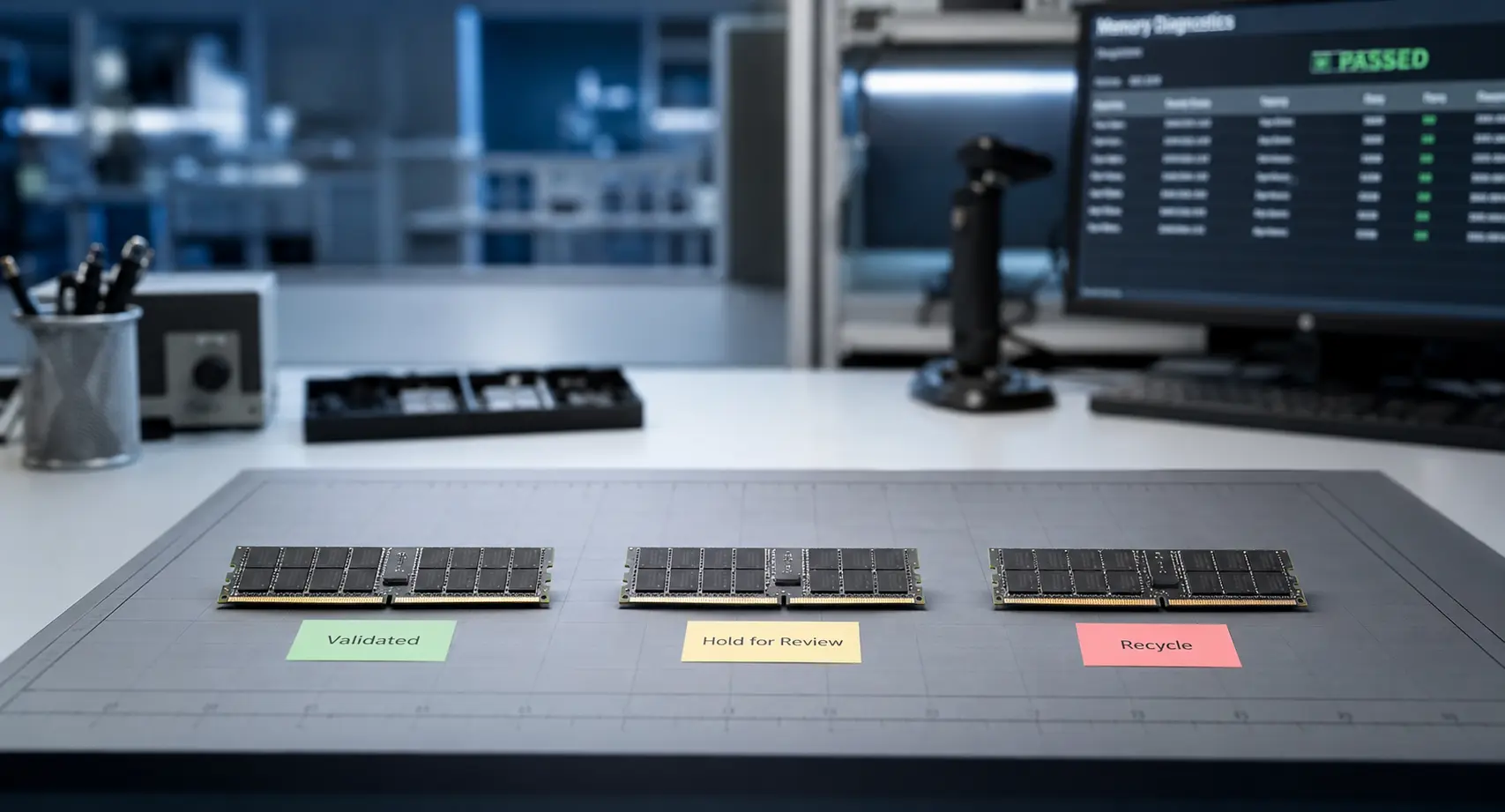
The move in the middle is classification. A part gets a disposition only after you've identified it, tested it against a defined standard, and written down the result. Not before.
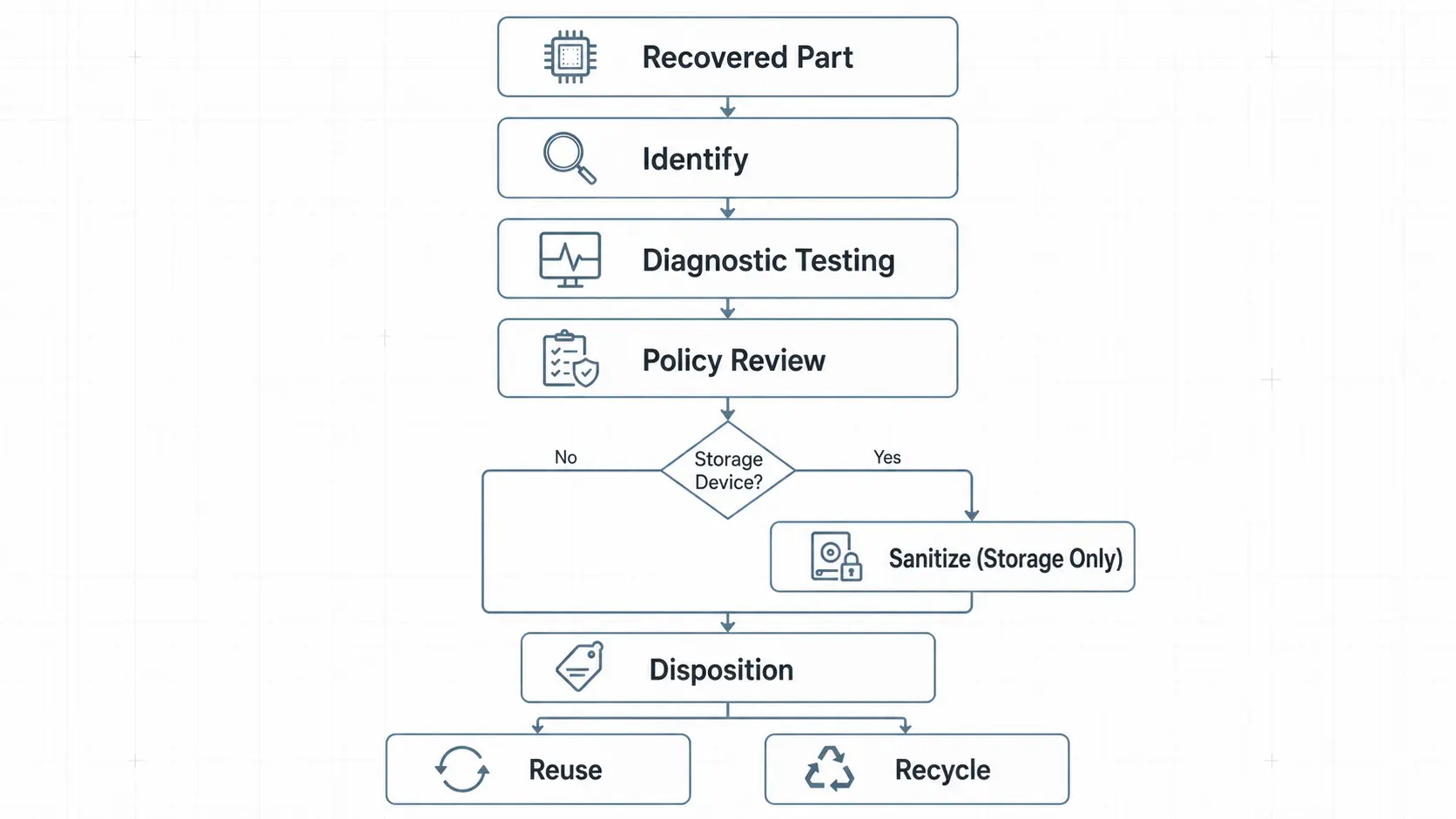
Recyclers, ITADs, and repair shops run that evaluation on PC-Doctor diagnostics, including PC-Doctor Factory and Service Center. The record shows what passed, what failed, and what was tested. That ties every part back to the decision you made about it. Refurbishment teams get evidence to support reuse. Recycling teams get a documented reason to keep bad hardware out of the next channel.
Memory Is Often a Good Candidate. A Boot Screen Isn't Proof.
Memory is one of the better candidates for a controlled reuse program. You can identify it by spec and test it for errors before it goes back on the shelf.
But a DIMM that boots a machine is not the same thing as reusable stock. Those are two different claims.
A credible program spells out what "validated" means. Confirm capacity and type. Test under a documented workload. Check compatibility in the platform it's headed for. Set a hard pass and fail line. The exact protocol tracks the system type, the promise you're making the customer, and the risk you're willing to carry.
The goal isn't zero risk. Nobody can sell you zero risk. The goal is a repeatable decision that beats a visual once-over and a successful boot.
Why one quick test is not enough
Memory faults don't all behave the same way. Some show up only with particular data patterns. Some when data changes state. Some when nearby cells get exercised, or only after the module has been under load for a while. That's why a successful boot, or a single short pass, can't by itself prove that recovered memory is ready for reuse.
PC-Doctor memory tests vary the patterns, the reads and writes, the address coverage, and the duration on purpose... to catch the faults a quick pass walks right past. That gives your team a defined, repeatable basis for the reuse call, instead of a gut read.
Storage Plays by Harder Rules
Storage is not memory with a different connector. Treat it that way and it will burn you.
A drive can pass every test today and still have no business entering a given resale channel. Health data, wear, error history, firmware state, interface compatibility, data-security obligations, warranty policy, the intended workload... all of it can decide where that drive is allowed to go.
Then there's the security question, and it's a separate one. Before a drive enters any reuse path, you need a documented sanitization process that fits your policy and your customer's obligations. A diagnostic result and a data-erasure record answer different questions. You often need both.
Say that part plainly. A passing diagnostic tells you the device's condition under the conditions you tested. It is not a blanket guarantee. It is not permission to resell.
So split the work. A short first test finds the obvious failures fast, before a tech burns an hour validating a drive that's already throwing errors. PC-Doctor Factory and Service Center let you start shallow and go deeper only when the drive or its destination calls for it... cleared, held, or pulled from reuse, with the same logic every time. And for a data-bearing drive that earns its way back in, PC-Doctor Drive Erase handles the sanitization step that turns the handoff to its next use into a documented one.
Validation Turns Parts Into Inventory You Can Defend
The price backdrop is what makes this discipline pay. Conventional DRAM and NAND flash prices jumped sharply in early 2026, and the forecasts still pointed up from there.23
That does not automatically make a recovered part the cheaper play. Testing costs. Handling costs. Inventory management costs. Warranty exposure costs. Pretending otherwise is how you talk yourself into a loss.
Here's the part that does hold. A component that clears a defined process stops being a gamble and starts being inventory. Known spec. Documented test result. A reuse path you can actually stand behind.
That flips the question from "can we save this part?" to "what can we responsibly say about this part?" The second question is better for the buyer, better for your operation, and better for the value of the system that eventually ships with that part inside it.
Trust Is a Process, Not a Label
The first article in this series covered why higher refurbished-PC prices raise buyer expectations. This is that same idea, one level down, at the component.
Buyers never see your part-classification process. They live with its result... systems that are consistent, traceable, and backed by a standard.
And that standard doesn't come from stamping a part "tested." It comes from being able to say what you tested, what passed, what you threw out, and how you recorded the call.
For PC-Doctor customers, diagnostics supply part of that evidence. A consistent way to evaluate hardware, and results your techs and locations apply the same way every time. The final disposition still belongs to you... your technical, security, and warranty policy make that call, not a single test result.
The Real Value of a Recovered Part
As supply tightens, recovered memory and storage get more valuable. But not for the reason you'd think.
Their value doesn't come from being used. It comes from being understood well enough to put them in the right next place... or to keep them out of circulation entirely.
That's the opportunity. Retain what meets the standard. Reject what doesn't. Document the difference.
Recovered isn't ready. Tested isn't cleared. And the refurbishers who win the next two years will be the ones who can tell you exactly which is which.
The PC-Doctor Engineering Team
Sources
-
IBM, "Arvind Krishna's Letter to IBM Investors," July 14, 2026. Clients shifted late-June capex toward servers, storage, and memory to secure supply-constrained infrastructure ahead of price increases. https://newsroom.ibm.com/2026-07-14-Arvind-Krishnas-Letter-to-IBM-Investors (see also IBM Form 8-K: https://www.sec.gov/Archives/edgar/data/0000051143/000005114326000070/ibm-20260714xex991.htm) ↩
-
TrendForce, "Memory Price Outlook for 1Q26 Sharply Upgraded, QoQ Increases of All Product Categories to Hit Record Highs," January 5, 2026. https://www.trendforce.com/presscenter/news/20260105-12860.html ↩
-
TrendForce, "AI Server Demand to Drive Memory Contract Price Increases in 2Q26," March 31, 2026. https://www.trendforce.com/presscenter/news/20260331-12995.html ↩

